Dubai has over 13,000 restaurants and cafés. A new concept opens almost every week — somewhere between Dubai Marina, City Walk, and JLT, another kitchen is launching with ambitious food and almost no marketing plan. Most restaurants that fail in Dubai don’t fail because of the food. They fail because nobody knows they exist.
Restaurant marketing in Dubai is a specific discipline. The tactics that work in London or New York — print ads, local press, loyalty cards — carry far less weight here. Dubai’s diners discover restaurants through Instagram first, Google second, and word of mouth third. If your presence in those channels is weak, you’re starting every week at a disadvantage. This guide covers the channels, strategies, and tactics that actually move covers in the Dubai market.
Why Restaurant Marketing in Dubai Is Different
Three market characteristics shape every effective restaurant marketing strategy in the UAE:
- —Visual discovery dominates. 70% of UAE diners rely on social media to choose where to eat, and 74% discover new restaurants through social channels — led by Instagram. In Dubai, a dish doesn’t just need to taste extraordinary; it needs to photograph extraordinarily. Poor food photography is one of the most expensive mistakes a Dubai restaurant can make.
- —The audience is genuinely global. Dubai’s dining population includes UAE nationals, Arab expatriates, South Asian communities, European professionals, tourists, and visiting business travellers. They don’t respond to the same content, speak the same languages, or book through the same channels. A content strategy that speaks to all of them requires intentional planning, not generic posts.
- —Third-party platforms own delivery, but not the customer. Talabat, Deliveroo, and Noon Food provide volume and exposure, but they charge 20–30% commission on every order and give you no customer data. A direct ordering channel — even a WhatsApp number with a digital menu — reduces commission dependency over time.
Food Photography: The Foundation of Dubai Restaurant Marketing
Before any platform strategy, channel plan, or ad spend, you need visual assets that make your food irresistible. In Dubai’s F&B market, this is not optional. Professional food photography can increase sales by up to 30% through menu and digital listings alone. More importantly, without strong visual content, every other marketing channel underperforms — you can’t run Instagram, you can’t run influencer campaigns, and even your Google Business Profile looks untrustworthy.
What professional food photography should deliver for a Dubai restaurant:
- —Hero shots of your five to eight highest-margin dishes in the best possible light — these anchor your digital menu, social feed, and Google listing
- —Atmosphere shots — the interior, the plating presentation, the ambience at different times of day
- —Short-form video content: 15–30 second Reels showing preparation, plating, or the dish being served — these consistently outperform static images in reach and engagement on Instagram and TikTok
- —Seasonal and campaign refreshes — menus and specials need updated photography at least quarterly to stay current
A professional F&B photography session in Dubai typically costs AED 2,000–5,000 for a half-day including editing. Monthly retainer arrangements with a food photographer — common among established Dubai restaurants — run AED 1,500–3,500/month for regular content delivery.
Instagram and TikTok: Your Primary Organic Channels
Instagram is where Dubai’s restaurant scene lives. Your feed, Stories, and Reels collectively form the first impression for a majority of potential guests. The accounts that consistently grow and convert have three things in common: consistent visual quality, a clear point of view, and regular content output.
What works on Instagram for Dubai restaurants in 2026:
- —Reels over static posts. Instagram’s algorithm heavily favours Reels for reach outside your existing followers. A 20-second video showing a signature dish being assembled outperforms a static photo of the same dish in reach by 3–5x on average.
- —Behind-the-scenes content. Showing the kitchen, the chef, and the sourcing story builds trust and personality. Dubai diners are increasingly sophisticated — they want to know the story behind the plate, not just the plate itself.
- —Bilingual captions. English-language captions with Arabic translations (or vice versa) reach both expat and local Emirati audiences. Arabic-language content specifically drives disproportionate engagement within UAE national and Arab expatriate communities, who are among the city’s most active diners.
- —Local hashtag and location tagging. Using specific Dubai district hashtags (#DubaiMarina, #BusinessBay, #JumeirahFood) and tagging your location consistently increases local discovery.
TikTok has grown rapidly in the UAE — particularly among younger Emirati audiences and South Asian expatriates. For budget-conscious restaurants, TikTok offers the highest potential for viral reach with zero paid spend, if the content is genuinely engaging. Food challenges, unique preparation techniques, and “what I ordered vs. what arrived” comparisons all perform well.
Google My Business and Local SEO: Capture Diners Already Searching
When someone searches “best brunch Dubai” or “Lebanese restaurant JLT,” Google’s local results pack appears before organic search results. Appearing in that pack — the three businesses shown with map pins — is consistently one of the highest-converting customer acquisition channels for restaurants in Dubai.
Getting into the local pack requires:
- —A fully optimised Google Business Profile (GBP) — with correct address, opening hours, phone number, website, and menu link
- —High-quality photos updated regularly (Google’s own data shows GBP listings with photos receive 42% more requests for directions)
- —Consistent review management — responding to every review within 24 hours, professionally, including negative ones
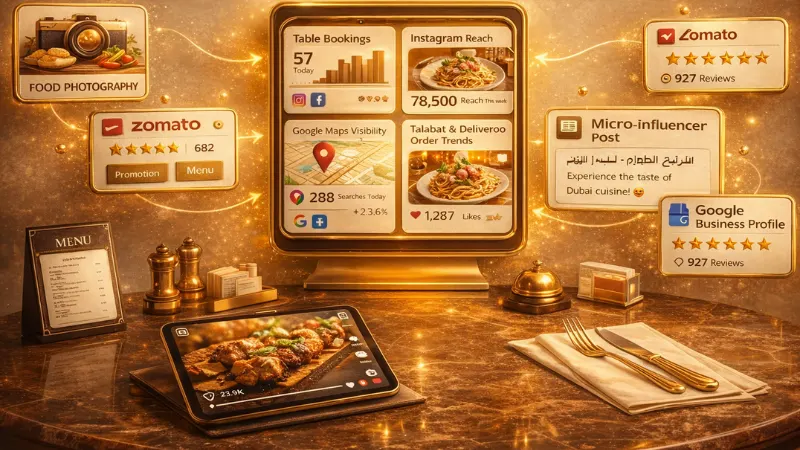
- —Ensuring your restaurant is listed accurately on Zomato, Talabat, TripAdvisor, and all major UAE food directories — consistency across these platforms signals authority to Google
Local SEO for restaurants also includes the website itself. A well-optimised restaurant website with menu pages, location keywords, and structured data (schema markup for restaurants) supports map pack rankings. Schema markup tells Google your opening hours, price range, cuisine type, and accepted payment methods — all of which appear directly in search results without requiring a click.
Influencer Marketing for Dubai Restaurants
UAE food influencer marketing is one of the most developed markets globally. Dubai has a deep ecosystem of food content creators ranging from macro-influencers (100,000+ followers) to micro-influencers (10,000–50,000 followers) who have highly engaged, local food-focused audiences.
Typical influencer fees in the UAE market:
- —Nano and micro-influencers (5,000–30,000 followers): Often willing to visit for a complimentary meal with content included, or charge AED 500–2,500 per post
- —Mid-tier influencers (30,000–100,000 followers): AED 2,500–8,000 per post or Reel
- —Macro-influencers and food bloggers (100,000+): AED 8,000–25,000+ depending on format and exclusivity
The highest-ROI approach for most Dubai restaurants is a consistent micro-influencer programme — hosting three to five micro-influencers per month for media dinners rather than spending large amounts on a single macro-influencer post. Micro-influencers consistently show higher engagement rates and conversion, and their audiences tend to be more locally concentrated and geographically relevant to your restaurant’s catchment area.
One Dubai-based agency achieved over 3 million views and a significant sales uplift for a client within three weeks using a targeted food influencer campaign, with zero paid placement fees — by engineering a genuinely unique, photographable product worth sharing. The product itself was the campaign. This is the most powerful form of restaurant marketing: building something worth talking about, then making it easy for the right people to talk about it.
Paid Ads for Dubai Restaurants: When and How
Organic reach alone rarely fills a restaurant in Dubai’s competitive market. Paid social advertising — primarily Instagram and Facebook ads — is the most effective paid channel for most F&B businesses, because it targets people by location, age, interests, and dining behaviour.
The most effective ad types for Dubai restaurants:
- —Location-targeted Instagram Reels ads targeting users within 3–5km of your restaurant, targeting relevant interest segments (dining out, food photography, etc.)
- —Table booking promotion ads around specific occasions — Ramadan Iftar promotions, National Day specials, Valentine’s Day set menus, and Dubai Shopping Festival deals all convert well
- —Retargeting ads to people who have visited your Instagram profile, website, or interacted with previous content
Google Ads are worth running for high-intent searches — “Iftar buffet Dubai 2026,” “fine dining marina view Dubai,” or “best sushi Dubai” — where someone is actively looking for your type of restaurant. CPCs for restaurant searches in Dubai are relatively affordable (AED 3–15 per click) compared to real estate or legal categories, and conversion intent is high.
WhatsApp: The Reservation and Retention Channel
WhatsApp is the most-used communication platform in the UAE across all demographics. For restaurants, it serves as a direct booking channel, a loyalty communication tool, and a customer service touchpoint. Posting your WhatsApp number prominently on Instagram, Google, and your website reduces booking friction dramatically — many Dubai diners prefer messaging over calling, and significantly prefer it over filling in a web form.
WhatsApp Business (the free version) allows you to set up an automated reply with your menu and booking information, handle reservation confirmations, and broadcast promotions to opted-in contacts. WhatsApp Business API (the paid version, managed through a BSP partner) enables proper CRM integration, automation, and larger-scale broadcast messaging — appropriate for restaurant groups and chains.
Delivery Platforms vs. Direct Ordering
Talabat, Deliveroo, and Noon Food collectively dominate food delivery in the UAE. For most Dubai restaurants, being listed on these platforms is table stakes — refusing to list means losing a significant share of delivery revenue to competitors who are listed. But being dependent on them is a different problem.
The commission model (typically 20–30% of order value) makes delivery profitability extremely challenging at low average order values. The strategic response is twofold: optimise your listings on the platforms to maximise organic ranking within their search (food photography and rating management matter here too), while simultaneously building a direct ordering channel — via WhatsApp, your own website, or a third-party direct ordering tool.
Our social media marketing team and content team work with F&B businesses in Dubai on the full range of restaurant marketing activities — from content strategy and food photography direction through to paid social campaigns and influencer programme management.
Frequently Asked Questions
Q
What is the best marketing strategy for a restaurant in Dubai?
The most effective restaurant marketing strategy in Dubai combines three pillars: strong visual content (professional food photography and Reels for Instagram/TikTok), local SEO through an optimised Google Business Profile, and regular influencer engagement with micro-influencers in the UAE food content community. Paid Instagram and Facebook ads targeting users within your catchment area amplify the organic programme once you have strong visual assets in place.
Q
How much does restaurant marketing cost in Dubai?
A foundational restaurant marketing programme in Dubai — covering social media management, food photography, and basic paid ads — typically runs AED 8,000–18,000 per month depending on scope. Food photography alone runs AED 2,000–5,000 per session or AED 1,500–3,500/month on retainer. Micro-influencer campaigns typically run AED 5,000–15,000/month at meaningful scale.
Q
Which social media platforms work best for Dubai restaurants?
Instagram is the primary platform for Dubai restaurant marketing, both for organic reach and paid advertising. TikTok is growing rapidly for viral food content targeting younger and South Asian audiences. Facebook remains relevant for older demographics and for event promotion. Snapchat has a strong Emirati user base and is worth considering for Ramadan campaigns targeting UAE nationals specifically.
Q
How do I get my restaurant on Google Maps in Dubai?
Claim and verify your Google Business Profile at business.google.com, ensure all information is accurate and complete (address, phone, hours, photos, menu link), and add your DED licence number to your profile description. Consistent positive reviews will improve your Map Pack ranking over time. Listing your restaurant consistently across Zomato, TripAdvisor, and Talabat reinforces your local search authority.
Related Reading
Paid social is one of the highest-ROI channels for F&B businesses. Our social media advertising Dubai guide covers Meta campaign structure for restaurant and hospitality brands.
Food influencers in Dubai can drive significant footfall. Our influencer marketing Dubai guide covers how to find the right creators and measure results.
TikTok food content performs exceptionally well in Dubai. Read our TikTok marketing Dubai guide for how F&B brands generate reach and walk-ins.
Getting discovered on Google Maps is fundamental for restaurants. Our local SEO Dubai guide covers Google Business Profile optimisation for F&B businesses.