
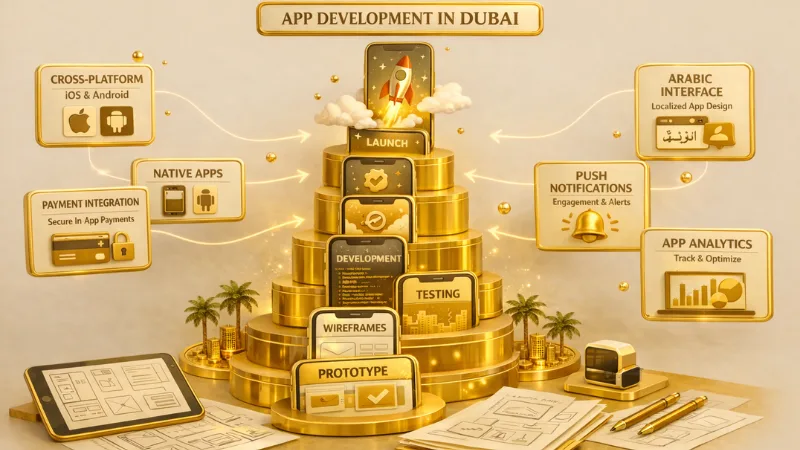

60,000 apps are submitted to the App Store every month. Most of them fail — not because the idea was bad, but because the build was rushed, the brief was vague, or the budget ran out before launch. In Dubai, where app development projects routinely cost between AED 50,000 and AED 500,000, that’s a painful outcome to avoid.
This guide is for business owners and managers in the UAE who are considering building a mobile app and want to understand the full picture before committing: what the process involves, how costs are structured, where budgets typically blow out, and how to choose an app development company in Dubai that will actually deliver.
Why Dubai Businesses Are Investing in App Development
The UAE’s mobile app market is projected to reach AED 2.5 billion by 2027, growing at roughly 14% annually. Smartphone penetration in the UAE exceeds 91%, and government-backed smart city programmes — including the Dubai Digital Authority’s push for digitised public and private services — are creating commercial pressure on businesses to offer mobile-first experiences.
The sectors driving the most app development investment in Dubai currently include:
- —Real estate — property search, virtual tours, and investor portals
- —Retail and e-commerce — branded shopping apps, loyalty programmes, and order tracking
- —Healthcare — telemedicine, appointment booking, and patient management
- —Hospitality and F&B — delivery, reservations, and loyalty reward systems
- —Logistics and transport — fleet management, delivery tracking, and driver coordination
- —Fintech and payments — payment wallets, lending, and insurance platforms
Whatever the sector, the commercial logic is the same: a well-built app reduces friction for customers, creates direct communication channels, and generates data that informs business decisions.
How Much Does App Development Cost in Dubai?
App development costs in Dubai span a wide range because “app” is not a fixed product — it’s a description that covers everything from a five-screen utility app to a platform with real-time logistics, AI recommendations, and payment processing across multiple markets.
Here’s how the cost tiers break down in the UAE market in 2026:
| App Type | Cost Range (AED) | Timeline | Examples |
|---|---|---|---|
| Simple / MVP | AED 25,000–80,000 | 2–4 months | Booking app, info utility, basic catalogue |
| Medium complexity | AED 80,000–200,000 | 4–7 months | E-commerce app, social features, payment integration |
| Complex / Platform | AED 200,000–500,000+ | 7–12 months | Marketplace, fintech, on-demand logistics, AI-powered tools |
| Enterprise / Custom | AED 500,000+ | 12 months+ | Multi-role platform, ERP integration, regional scale |
The AED 25,000–50,000 range that some agencies quote is typically for a Minimum Viable Product (MVP) — a focused, limited-feature build designed to test market fit before investing in full development. An MVP is a legitimate strategy, but it’s important to understand that an MVP is not a finished product. Budget for the full version from the start.
What Drives the Cost of Your App
Feature Complexity
This is the single largest cost driver. Each feature adds development time. Some features that push apps into higher cost tiers:
- —Real-time tracking (GPS, driver or delivery updates) adds four to eight weeks of development
- —Payment gateway integration (Apple Pay, Visa, Tabby, Postpay for UAE BNPL) adds two to four weeks
- —AI-driven personalisation or recommendation engines add 30–50% to base development cost
- —Multi-language support, including Arabic RTL layouts, adds one to three weeks
- —Admin dashboards, CRM integrations, or third-party API connections each add independent development scope
Platform Choice: iOS, Android, or Both
Building native apps for both iOS and Android — written separately in Swift and Kotlin respectively — delivers the best performance and deepest OS integration, but roughly doubles the development cost compared to a single platform.
Cross-platform frameworks like Flutter and React Native allow developers to write one codebase that deploys on both platforms, saving 30–40% on development cost. Performance and user experience are marginally below native in complex apps, but for most business applications the trade-off is worthwhile. In 2026, Flutter has become the default recommendation for most mid-range app projects in Dubai.
Developer Location and Billing Model
Local Dubai-based agencies charge AED 200–350 per hour for full-service delivery including project management, design, development, and QA. A mid-level developer hired directly in Dubai costs AED 25,000–45,000 per month in salary.
Many UAE-based agencies use hybrid models: product management and client-facing work handled locally, with development work done by teams in India, Eastern Europe, or Southeast Asia. This approach can reduce costs by 30–60% without sacrificing quality if the agency has strong oversight processes. The key question when evaluating any agency is: who exactly will be doing the work, and where?
Post-Launch Maintenance
Plan for 15–20% of your initial development cost per year in ongoing maintenance. This covers OS updates (Apple and Google release major updates annually that require app testing and fixes), security patches, bug resolution, and feature additions. A AED 150,000 app requires AED 22,500–30,000 per year in maintenance to stay functional, secure, and compliant.
The App Development Process: Stage by Stage
Stage 1 — Discovery and Scoping (2–4 weeks)
A serious app development company starts with a structured discovery phase: mapping user journeys, defining feature scope, reviewing technical constraints, and producing a detailed project brief and cost estimate. This is also when UAE-specific requirements are identified — Arabic language support, UAE Federal Data Protection Law (PDPL) compliance, and integration with UAE-specific payment systems.
Agencies that skip discovery and give you a quote in 48 hours based on a brief phone call are pricing blind. Expect any reputable agency to charge AED 5,000–15,000 for a proper discovery engagement, or to include it in the project cost with a clearly documented output.
Stage 2 — UX Design and Wireframing (2–4 weeks)
Before a single line of code is written, designers produce wireframes — simplified screen-by-screen layouts that show how users move through the app without any visual polish. Wireframes let you validate the user experience logic before the expensive development phase begins.
UI design follows: the actual visual interface with colours, typography, icons, and micro-interactions. For UAE apps, bilingual UI design — building both English (left-to-right) and Arabic (right-to-left) versions of every screen — is a critical and often undercosted step.
Stage 3 — Development (8–24 weeks depending on complexity)
Development runs in sprints — typically two-week cycles where the team builds a defined set of features, tests them, and presents progress. A well-run sprint model gives you visibility throughout the build rather than a “big reveal” at month six.
Backend development (server, database, and APIs) is where complexity and cost often surprise clients. If your app needs real-time data sync, user data storage, admin management, or third-party integrations, the backend can account for 30–50% of total development cost.
Stage 4 — QA and Testing (2–4 weeks)
Testing covers device compatibility (iOS and Android across various screen sizes), performance under load, security testing, and user acceptance testing. For apps handling financial transactions or personal health data, additional compliance testing is required under UAE regulations.
Stage 5 — App Store Submission and Launch
Apple App Store review typically takes three to seven days. Google Play Store reviews are faster, usually one to three days. Both require developer account fees: Apple charges $99/year (~AED 363) and Google charges a one-time $25 (~AED 92) registration fee.
Factor in App Store Optimisation (ASO) as a post-launch priority — the title, description, screenshots, and keyword targeting for your app listing directly affect how many relevant users find and download it. This mirrors SEO for websites.
Choosing an App Development Company in Dubai
Dubai has over 2,000 registered app development companies and freelancers. The quality range is enormous. Here’s what to evaluate before signing a contract:
Portfolio and Live App Evidence
Ask to see apps they’ve built that are currently live in the App Store or Google Play. Download them. Use them. A polished agency presentation with screenshots is not the same as a functioning, well-reviewed app in production. If their portfolio apps have low ratings, crash reports, or haven’t been updated in two years, that tells you something about their post-launch support culture.
Process Transparency
How do they handle scope changes? What happens if the project runs over timeline? What does their sprint review process look like? How is QA structured? Any agency that can’t answer these questions clearly has no structured process. You’ll be managing the project yourself.
Arabic and UAE-Specific Expertise
Ask specifically: “Have you built apps with Arabic language support and RTL layouts?” Arabic text handling, bidirectional layout, and font rendering require specific technical knowledge. Not all developers have it. Verify before proceeding.
Ongoing Support Contract
What happens after launch? Your app will need maintenance, OS updates, and feature additions. Get the post-launch support model in writing before you sign. Agencies that disappear after delivery create expensive problems at exactly the wrong moment.
What a App Costs to Build vs. What It Costs to NOT Build
When we work with UAE businesses on their digital strategy — including how apps fit into their broader web and mobile development plans — one of the most useful framing exercises is cost-avoidance: what is the operational cost of not having an app?
For a Dubai F&B business handling 100 orders per day through third-party delivery platforms, a 15–25% platform commission on every order adds up to AED 150,000–300,000 in annual commission at an average order value of AED 60. A branded app with direct ordering — built for AED 80,000–120,000 — pays for itself within six to eight months, with full ownership of customer data as the compounding benefit.
The same logic applies to real estate agents paying high CRM subscription fees, healthcare providers managing appointment friction, or retail brands losing loyalty programme data to third-party platforms. Build costs should always be evaluated against the alternative cost of the status quo.
Frequently Asked Questions
Q
How much does it cost to develop an app in the UAE?
Most business apps built by Dubai-based agencies or through hybrid models cost between AED 50,000 and AED 300,000. Simple MVPs start around AED 25,000–35,000. Complex platforms with real-time features, AI integration, or marketplace logic can exceed AED 500,000. The most accurate estimate comes from a proper scoping session with a defined feature list.
Q
How long does app development take in Dubai?
Simple apps with focused features typically take two to four months. Medium-complexity apps with payment integration, user accounts, and backend functionality run four to seven months. Complex platforms with multiple user roles, real-time data, and enterprise integrations take seven to twelve months or more.
Q
Should I build a native app or use a cross-platform framework?
For most UAE business applications, cross-platform development using Flutter or React Native delivers the best cost-to-performance ratio. Native development (Swift for iOS, Kotlin for Android) is worth the higher cost for apps with deep OS integration needs — camera-intensive apps, AR features, or very high-performance requirements. For standard business apps, Flutter reduces cost by 30–40% with minimal functional trade-off.
Q
What is the best mobile app development company in UAE?
The best company for your project depends on your budget, sector, technical requirements, and whether you need Arabic language support. Evaluate companies based on live apps in their portfolio, process transparency, bilingual development experience, and the clarity of their post-launch support offering — not agency size or social media presence.
Q
What are the ongoing costs after an app launches?
Budget 15–20% of your initial development cost per year for maintenance: OS updates, security patches, bug fixes, and minor feature additions. Hosting and backend infrastructure adds AED 500–3,000/month depending on scale. App Store Optimisation (if outsourced) runs AED 2,000–5,000/month for active management.
Related Reading
If your project spans both web and mobile, our web development Abu Dhabi guide covers full-service development partnerships in the UAE.
For retail businesses deciding between an app and an ecommerce website, our ecommerce website development Dubai guide provides a helpful comparison.