
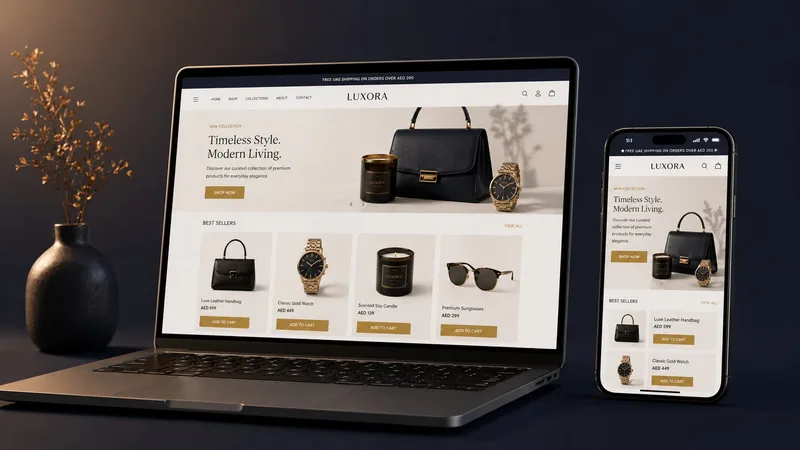

Building an ecommerce website in Dubai is not the same as building one in London or New York. The UAE market has specific payment gateway requirements, Arabic language considerations, a mobile-first audience that expects fast loading times, and regulatory nuances around online selling that your development team needs to understand from the start.
Whether you’re launching your first online store or migrating from a platform that’s holding you back, this guide gives you a complete picture of what ecommerce website development in Dubai involves, what it costs, and how to choose the right team.
Why Ecommerce in Dubai Is a Major Opportunity Right Now
The UAE is one of the fastest-growing ecommerce markets in the world. Statista projects the UAE ecommerce market will exceed USD 9 billion by 2026, with Dubai accounting for the dominant share. Online shopping adoption accelerated significantly post-pandemic and has not reversed.
Key drivers of UAE ecommerce growth:
– Among the highest smartphone penetration rates globally
– A young, digitally native population with high disposable income
– Widespread adoption of digital payments (Apple Pay, PayTabs, Telr, Tabby, Tamara)
– Government support through Digital Dubai and UAE Vision 2031 initiatives
– Buy-now-pay-later (BNPL) penetration enabling higher average order values
For businesses selling physical products, digital goods, or services through a transactional website, the timing to invest in ecommerce infrastructure has never been better.
Choosing the Right Ecommerce Platform for Your UAE Store
Platform selection is the most important technical decision you’ll make. The right choice depends on your product type, order volume, customisation requirements, and long-term growth plans.
Shopify
The dominant choice for UAE ecommerce businesses, particularly SMEs and D2C brands. Shopify’s advantages:
- —Fast to launch (weeks, not months)
- —Strong ecosystem of UAE-compatible payment gateways (PayTabs, Checkout, Tabby, Tamara)
- —Built-in mobile optimisation
- —Easy to manage without technical knowledge
- —Excellent for Arabic-language stores with RTL support
Shopify’s limitations are mainly felt at high complexity: heavily customised workflows, large product catalogues with complex variants, or deep ERP integrations may strain its architecture.
For a step-by-step Shopify launch guide for UAE businesses, read How to Set Up a Shopify Store in UAE.
WooCommerce (WordPress)
The most flexible self-hosted solution and the best choice if you need deep customisation, want full control over your hosting environment, or are integrating tightly with existing WordPress content infrastructure.
WooCommerce is more technical than Shopify — you’ll need a developer to set it up properly — but the flexibility ceiling is very high. UAE-specific payment gateways and Arabic language support are available through plugins.
Magento / Adobe Commerce
Enterprise-grade ecommerce for businesses with complex operations, large SKU counts, or multi-store requirements. Higher cost and complexity, but unmatched scalability. Typically suited to businesses with dedicated development resources or a long-term technology investment view.
Custom Development
Some businesses — particularly those with very specific operational workflows, proprietary product configuration tools, or deep integration requirements — opt for fully custom ecommerce builds. Costs are highest and timelines longest, but the result is a system built precisely around your business logic.
Key Features Your Dubai Ecommerce Website Must Have
Regardless of platform, any ecommerce site built for the UAE market should include:
Arabic language support (RTL): A significant portion of your potential customers prefer Arabic. A dual-language store (English and Arabic) can meaningfully expand your market reach. Ensure your development team has genuine RTL experience — half-hearted Arabic implementations look unprofessional and hurt trust.
UAE-compatible payment gateways: Visa and Mastercard credit card processing is table stakes. Additionally, integrate at least one BNPL option (Tabby and Tamara dominate the UAE market) and consider Apple Pay / Google Pay for frictionless mobile checkout.
Cash on delivery option: Despite the growth of digital payments, a segment of UAE consumers still prefers COD — particularly for first-time purchases from unfamiliar brands. Removing this option may cost you conversions.
Mobile-first design: Over 70% of UAE ecommerce traffic comes from mobile devices. Your store’s mobile experience needs to be fast, clean, and frictionless. Test on multiple device sizes before launch.
Fast loading times: UAE consumers have high expectations for site speed. A store that takes more than 3 seconds to load will see significantly elevated bounce rates. Proper image optimisation, CDN configuration, and clean code architecture are non-negotiable.
Secure checkout (SSL, PCI compliance): UAE consumer trust in online payments has grown, but it remains sensitive. HTTPS, clear security badges, and a professional checkout experience are essential.
Delivery and returns clarity: Display shipping costs, timelines, and return policies prominently. Ambiguity here is a leading cause of cart abandonment in the UAE market.
Ecommerce SEO: Getting Your Store Found on Google
A beautifully built store that nobody can find on Google is an expensive disappointment. Ecommerce SEO should be considered from day one — not bolted on afterwards.
Key ecommerce SEO requirements for UAE stores:
- —Product page optimisation: Unique, keyword-rich product titles and descriptions; no duplicate content across variants
- —Category page optimisation: Category pages often have higher search volume than individual products and should target broad transactional keywords
- —Site structure: A clean, crawlable URL structure (e.g., /category/product rather than /product?id=1234)
- —Page speed: A significant Google ranking factor — especially on mobile
- —Schema markup: Product schema (price, availability, reviews) enables rich snippets in search results
- —Local SEO: If you have a physical store alongside your online presence, local signals reinforce both
For a detailed guide on ranking your UAE ecommerce store, read our Ecommerce SEO Dubai guide.
Ecommerce Website Development Costs in Dubai
Development costs vary widely based on platform, complexity, and the team you work with. Here’s a realistic breakdown:
| Store Type | Platform | Estimated Cost (AED) | Timeline |
|---|---|---|---|
| Basic starter store (< 50 products) | Shopify | 5,000 – 12,000 | 2–4 weeks |
| Mid-size store with custom design | Shopify / WooCommerce | 15,000 – 35,000 | 4–8 weeks |
| Multi-language (EN + AR) store | WooCommerce / Shopify | 20,000 – 50,000 | 6–10 weeks |
| Enterprise / complex integration | Magento / Custom | 80,000 – 250,000+ | 3–6 months |
These ranges assume a professional UAE-based development team. Offshore development at a fraction of these prices is available but carries significant risks: poor quality, communication delays, no understanding of UAE-specific requirements, and limited post-launch support.
For broader context on website development pricing in the UAE, see Website Development Cost in UAE (2026).
What to Look for in a Dubai Ecommerce Development Agency
UAE market knowledge. Payment gateways, Arabic RTL, UAE consumer behaviour, local logistics integrations (Aramex, Fetchr, UAE-based 3PLs) — your development team should have hands-on experience with these, not just theoretical understanding.
Post-launch support. An ecommerce site requires ongoing technical maintenance: platform updates, security patches, performance monitoring, and conversion optimisation. Choose a team that offers a post-launch support agreement, not just a handover and goodbye.
Design and UX capability. Conversion rate optimisation starts at the design stage. A development team that understands how UAE consumers behave on mobile, what trust signals matter, and how to reduce cart abandonment will build a store that performs, not just one that looks good.
Transparent project management. Clear milestones, regular updates, and a defined process for handling changes and revisions. Vague project management leads to scope creep, blown budgets, and missed deadlines.
Working with Valasys Media on Your Ecommerce Build
Valasys Media develops ecommerce websites for UAE businesses across platforms including Shopify and WooCommerce. Our team combines development expertise with digital marketing knowledge — meaning the store we build for you is designed not just to function, but to rank on Google, convert visitors, and scale with your business.
We handle everything from platform setup and custom design through to payment gateway integration, Arabic language implementation, SEO foundations, and post-launch support. Contact our team to discuss your ecommerce project.
Before You Build: 5 Questions to Answer First
Before commissioning any ecommerce development, be clear on:
- —What platform best fits your long-term needs? Don’t choose based on cost alone — choose based on where you want to be in three years.
- —Who will manage the store day-to-day? Someone on your team needs to own product updates, orders, and customer service once the site is live.
- —What’s your traffic strategy? A new store with no SEO or ads will get zero visitors on launch day. Plan your marketing alongside your development.
- —How will you handle fulfilment and returns? Your technology needs to align with your operational reality.
- —What does success look like in 6 months? Define your targets before you build so you can measure whether your investment is working.
Conclusion
Ecommerce website development in Dubai is an investment that pays back when done correctly — on the right platform, with UAE-specific features, proper SEO foundations, and ongoing marketing support. It underperforms when treated as a one-time build-and-forget project.
The opportunity in the UAE market is real and growing. The businesses that build well now will have a compounding advantage as the market matures.
Ready to launch or upgrade your UAE online store? Get in touch with Valasys Media for a free consultation and project scoping session.
Frequently Asked Questions: Ecommerce Website Development Dubai
Q
How much does ecommerce website development cost in Dubai?
Ecommerce website development in Dubai typically costs AED 5,000–12,000 for a basic Shopify store, AED 15,000–35,000 for a mid-size store with custom design, and AED 20,000–50,000+ for a bilingual Arabic/English store. Enterprise builds on Magento or fully custom platforms can run AED 80,000–250,000+. Costs depend on platform choice, product catalogue complexity, design requirements, and the integration of Arabic language and UAE-specific payment gateways.
Q
Which ecommerce platform is best for UAE businesses — Shopify or WooCommerce?
For most UAE SMEs and D2C brands, Shopify is the better starting point: faster to launch, easier to manage without technical knowledge, and well-supported by UAE payment gateways (PayTabs, Tabby, Tamara). WooCommerce is the better choice if you need deep customisation, already have a WordPress website, or want full control over your hosting. If you’re scaling to enterprise level with complex operations, Magento or a custom build may be warranted.
Q
What payment gateways should a UAE ecommerce store support?
At minimum: Visa/Mastercard credit and debit card processing through a reputable UAE-compatible gateway (PayTabs, Checkout.com, or Telr are popular options). Additionally, integrate at least one buy-now-pay-later option — Tabby and Tamara are the dominant BNPL platforms in the UAE. Apple Pay and Google Pay are increasingly expected for frictionless mobile checkout. Cash on delivery (COD) should also be available, particularly for new brands building customer trust.
Q
How long does it take to build an ecommerce website in Dubai?
A basic Shopify store can be built and launched in 2–4 weeks. A mid-size store with custom design and bilingual capability typically takes 4–8 weeks. Enterprise or custom builds can take 3–6 months. Timeline depends heavily on how quickly the client can provide content, product data, and feedback during the design and review stages.
Q
Do I need an Arabic version of my UAE ecommerce store?
For most UAE consumer-facing stores, yes. Arabic-speaking consumers — Emirati nationals and Arab expats — represent a significant share of the UAE’s purchasing population. A properly implemented Arabic (RTL) version of your store, with accurate professional translation and Arabic-language product descriptions, meaningfully expands your addressable market. Arabic ecommerce pages also face less SEO competition than English equivalents.
Q
What are the most common mistakes in UAE ecommerce website development?
The most common mistakes are: choosing a platform based on cost rather than long-term fit, launching without SEO foundations in place, neglecting mobile experience (70%+ of UAE ecommerce traffic is mobile), not implementing Arabic language support, using payment gateways that aren’t trusted by UAE consumers, and treating the website as a one-time build rather than an ongoing asset requiring maintenance and optimisation.