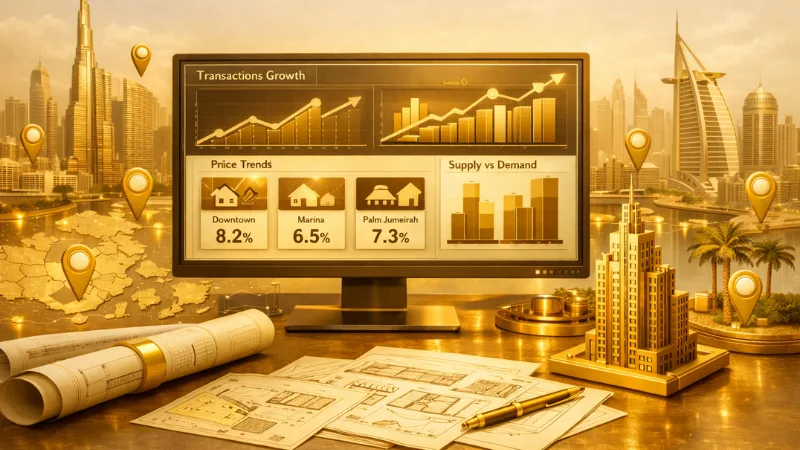

Dubai closed 2025 with over 205,000 residential sales transactions — an 18% increase from an already record-setting 2024. Total transaction value reached AED 539.9 billion. That momentum carried straight into January 2026, which recorded AED 107.96 billion in transactions in a single month, more than double the same month the previous year.
The question heading into 2026 isn’t whether the market is active. It clearly is. The question is what kind of year it will be — and for whom. This analysis covers the key trends, price expectations, area performance, and investment outlook for Dubai real estate in 2026, drawing on data from the Dubai Land Department, Cushman & Wakefield Core, Knight Frank, Engel & Völkers, and The National.
The Big Picture: From Growth Cycle to Stability Phase
The 2021–2025 growth cycle delivered exceptional returns across Dubai’s residential market. Villa prices in established communities rose by more than 200% from pandemic lows. Apartment prices in well-connected mid-market areas surpassed their previous all-time highs for the first time. Rental yields held firm at 5–9%, outperforming comparable global cities.
2026 marks a transition. Cushman & Wakefield Core describes it as Dubai entering “a more balanced phase.” Price appreciation is forecast to moderate to 5–8% for the year — not a reversal, but a normalisation after three years of 13–22% annual growth. For investors who entered the market in 2021–2022 and are thinking about exit strategies, this is still a very positive environment. For new buyers, moderation means less pressure to rush.
The IMF forecasts UAE economic growth of approximately 5% in 2026, the fastest rate among GCC countries and well above the global average. That macro backdrop — combined with the government’s long-term visa reforms, 100% foreign ownership in free zones, zero property tax, and zero capital gains tax — continues to differentiate Dubai from most global property markets.
Price Trends by Segment in 2026
Villas and Townhouses
Villas have led the market throughout the growth cycle and remain the most supply-constrained segment heading into 2026. Established, low-density communities — Palm Jumeirah, Dubai Hills Estate, Arabian Ranches, and Jumeirah Park — continue to attract strong end-user and investor demand. New supply in the villa segment is genuinely limited by land availability in mature communities. Price appreciation in the 6–10% range is forecast for prime villa communities, with some outperformance in trophy locations.
Apartments
The apartment market is more nuanced in 2026. Well-connected mid-market communities — Jumeirah Village Circle (JVC), Business Bay, Dubai Marina, and JLT — have absorbed supply well and continue to show solid rental demand from the city’s large professional expat population. JVC recorded 7,800+ transactions in 2025 — the highest of any single community by DLD data.
Areas with high new supply concentration are the watch point. An estimated 72,000 residential units are scheduled for completion in Dubai in 2026, though historical delivery rates suggest 40,000–47,000 will actually be handed over. Communities in Dubai South, Dubailand, and MBR City are absorbing the largest volumes of new supply; competition between units in these areas is likely to put pressure on both sale prices and rental yields through 2026.
Luxury and Ultra-Luxury
The luxury segment continues to outperform. Dubai’s market average sits around AED 1,676 per square foot — notably accessible compared to London (AED 5,000+/sqft), Monaco (AED 18,000+/sqft), or New York. This relative value, combined with zero capital gains tax and a 10-year Golden Visa programme for property investors above AED 2 million, continues to attract high-net-worth buyers from Europe, South Asia, Russia, China, and the Middle East. January 2026 showed a distinct buyer shift toward luxury and premium residential assets in transaction data.
Rental Market Outlook
After three years of double-digit annual rent increases, rental growth is moderating. Average rent growth in 2026 is expected to run at 6–8% in key communities — positive, but slower than the 14% year-on-year pace recorded in early 2025.
The new supply pipeline will give tenants more choice in some areas, improving their bargaining position. This is most likely to be felt in apartment-dense emerging communities rather than established mid-market or villa communities where demand remains structurally strong.
Rental yields of 5–9% make Dubai one of the highest-yielding major real estate markets in the world. A AED 1 million apartment yielding 7% net generates AED 70,000 in annual rental income — with no tax on that income. In comparable global cities, net yields after tax and ownership costs are typically below 3%.
Off-Plan vs. Ready Properties in 2026
Off-plan sales dominate Dubai’s transaction landscape, driven by developer payment plans (many structured at 1% per month), lower entry prices versus ready stock, and the potential for capital appreciation between purchase and handover. Off-plan transactions accounted for the majority of the 2025 record volumes.
However, 2026 is a more selective market for off-plan. Developer reputation matters more as the pipeline grows. Tier-1 developers — Emaar, Aldar, DAMAC, Meraas, Sobha — have strong delivery track records. Off-plan projects from lesser-known developers in fringe locations carry meaningfully higher risk in a market where 40,000+ units are expected to be delivered in the same year.
Ready properties offer immediate rental income and eliminate handover risk. For income-focused investors, ready stock in high-demand rental communities (Business Bay, Dubai Marina, JVC) provides more predictable returns in a moderating price environment.
Key Areas to Watch in 2026
| Area | Segment | 2026 Outlook | Key Driver |
|---|---|---|---|
| Palm Jumeirah | Luxury villas / apartments | Continued appreciation, limited supply | Global HNW buyer demand |
| Dubai Hills Estate | Villas and townhouses | Strong family-end-user demand | Schools, parks, community maturity |
| Business Bay | Apartments | High liquidity, 7.4% rental yield on 1-beds | Professional renters, canal access |
| JVC | Affordable apartments | Highest transaction volume by community | Relative affordability, strong rental demand |
| Dubai South / Expo City | Off-plan | Growth potential, higher supply risk | Infrastructure investment, Al Maktoum Airport |
| Dubai Creek Harbour | Off-plan apartments | Strong developer pipeline (Emaar) | Waterfront positioning, infrastructure delivery |
What This Means for Real Estate Businesses in Dubai
Market moderation changes buyer behaviour in ways that directly affect how real estate agents, developers, and property management companies need to compete. In a hot market, inventory moves fast and marketing is secondary. In a balanced or cooling market, visibility and lead quality become decisive.
Three shifts are already visible in the market:
- —Off-plan buyers are doing more research. With more projects competing for attention, buyers spend longer comparing options online before making contact. Developers and agents who don’t rank in Google search for relevant community and project terms are losing leads before any conversation starts.
- —Rental-focused investors are comparing yields more carefully. Content that clearly explains net yields, service charges, and community-level demand data earns trust with data-driven investors. Generic “invest in Dubai” messaging no longer differentiates.
- —International buyers need digital-first journeys. European, Indian, and Chinese buyers — major demand sources in 2025 and 2026 — do most of their Dubai property research online before arriving in the country. Targeted digital marketing to these geographies, including paid social in their home languages, is an underdeveloped area for most Dubai agencies.
If you manage a real estate business in Dubai and your digital marketing hasn’t kept pace with the volume of competition, 2026’s more balanced market is the moment to fix that. Our content marketing and SEO teams in Dubai work with property businesses to build the kind of digital visibility that generates qualified leads year-round — not just during peak market periods.
The Tokenisation Trend: Early Stage, Real Direction
One longer-term development worth noting: Dubai Land Department launched a pilot integrating blockchain-based property titles into the land registry in late 2025, with a focus on tokenised and fractional ownership. This initiative could eventually allow smaller investors to take fractional stakes in Dubai properties, broadening the investor base and improving market liquidity.
This is early-stage, and practical implications for most buyers and agents are limited in the near term. But for real estate businesses watching where the market is heading, it signals the direction of regulatory thinking — and early positioning around fractional investment content and digital-first transaction support is a strategic opportunity.
Frequently Asked Questions
Q
What is the prediction for Dubai real estate in 2026?
Dubai real estate in 2026 is expected to see positive but moderated price growth of 5–8% for the year, following three years of 13–22% annual appreciation. The market is transitioning from a rapid growth phase to a more balanced, sustainable stage. Villas and luxury assets are forecast to outperform apartments in areas with high new supply concentration.
Q
Is it a good time to invest in Dubai real estate?
Dubai’s investment fundamentals remain strong in 2026: zero property tax, zero capital gains tax, rental yields of 5–9%, a 100% foreign ownership framework, and GDP growth forecast at 5%. The shift to a more balanced market gives buyers more choice and time for due diligence. The investors likely to do best in 2026 are those focused on proven communities, tier-1 developers, and a three-to-five-year holding horizon rather than short-term flipping.
Q
Is now a good time to sell property in Dubai?
For sellers in established communities with strong rental demand and limited new supply, 2026 remains a favourable environment. Transaction volumes are high, and buyer appetite — particularly from international investors — remains active. Sellers in communities with large new supply pipelines may face more price competition as buyers have more options. Timing and community matter significantly.
Q
What is the outlook for the Dubai real estate market in the next 5 years?
Over the next five years, Dubai’s real estate market is supported by structural tailwinds: continued population growth (the city is targeting 5.8 million residents by 2040), large infrastructure investment including Al Maktoum Airport expansion, ongoing attractiveness for international capital, and a regulatory environment that makes ownership accessible for foreigners. Price appreciation over five years is likely to be slower than the 2021–2026 cycle, but income returns through rental yields should remain competitive globally.
Related Reading
Understanding market trends is the first step. Translating that into leads and listings requires a targeted real estate marketing strategy in Dubai built for 2026’s buyer behaviour.
For agents and developers looking to convert market interest into enquiries, our lead generation Dubai guide covers the channels that work best in the property sector.