
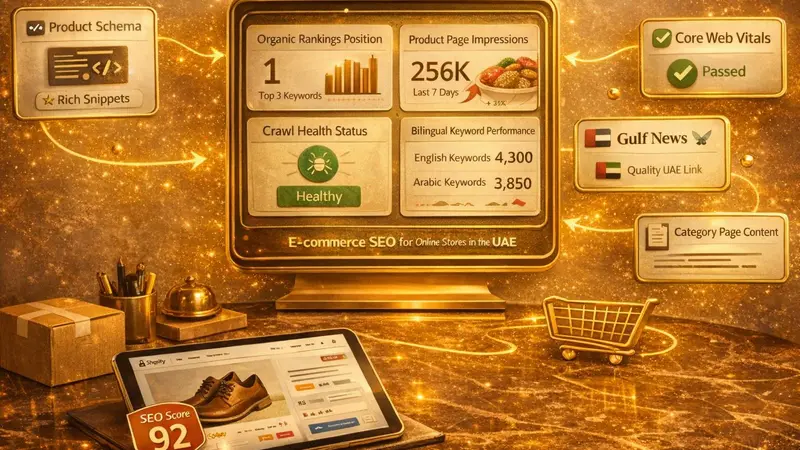

The UAE’s e-commerce market is projected to exceed USD 8 billion by 2026. Google captures over 95% of UAE search traffic. That combination means a well-ranked online store in Google.ae is one of the most valuable commercial assets a Dubai e-commerce business can build — generating daily organic traffic that grows compounding without per-click costs.
E-commerce SEO in Dubai is a specific challenge. Generic global SEO guides miss the UAE-specific factors that determine whether your Shopify or WooCommerce store ranks for the searches that actually convert in this market. This guide covers the technical, content, and off-page strategies that work for Dubai e-commerce sites in 2026.
Why E-commerce SEO in Dubai Is Different
Three factors make UAE e-commerce SEO distinct from markets like the US or UK:
- —Bilingual search behaviour. UAE consumers search in both English and Arabic, often within the same purchase research journey. Ranking only for English keywords misses a significant portion of organic demand — particularly for categories like fashion, food, beauty, and home goods where Arabic-language searches are common among UAE national and Arab expatriate buyers.
- —Google Shopping is underutilised. Many Dubai e-commerce businesses haven’t configured Google Shopping campaigns or Merchant Centre feeds. This means their product listings don’t appear in the rich product snippets that appear at the top of product search results. Competitors using Shopping ads and structured product data capture these high-intent placements while sites without it are invisible there.
- —High competition from international retailers. UAE consumers have access to Amazon.ae, Noon, and international brands with substantial SEO authority. Competing on broad keywords is harder than in smaller markets. The strategy must emphasise niche depth, local content advantage, and category-level authority rather than brute-force domain authority.
Technical SEO for Dubai E-commerce Sites
Technical SEO is the foundation that determines whether Google can crawl, understand, and rank your product pages at all. For e-commerce sites with large catalogues, technical issues can cause hundreds or thousands of pages to be invisible to search engines — a silent killer of organic traffic.
Site Speed and Core Web Vitals
Google’s Core Web Vitals — Largest Contentful Paint (LCP), Interaction to Next Paint (INP), and Cumulative Layout Shift (CLS) — directly affect rankings. E-commerce sites commonly fail these scores due to unoptimised product images, heavy theme JavaScript, third-party app scripts, and lack of caching. For UAE stores, a local or UAE-CDN-routed server dramatically improves LCP scores for the primary customer audience.
Use Google PageSpeed Insights to identify your current scores. Most Shopify and WooCommerce stores we audit for UAE clients are in the 30–55 range on mobile — well below the 70+ threshold needed for competitive rankings. The most common fixes: compress product images to WebP format (typically 60–80% size reduction with no visual quality loss), defer non-critical JavaScript, and enable server-side caching with a plugin like WP Rocket for WooCommerce.
Site Architecture and Internal Linking
E-commerce site architecture should follow a logical hierarchy: Homepage → Category pages → Subcategory pages → Product pages. Every category and subcategory page should have SEO-optimised content — not just a product grid. Google needs content to understand what a page is about and rank it accordingly.
Internal linking distributes authority (PageRank) across your site. Best practice:
- —Link from homepage to your top-priority category pages
- —Cross-link related product categories (“Shop our full range of moisturisers”)
- —Link from blog content to relevant category and product pages — blog posts often rank for informational queries and pass authority to commercial pages
Crawlability and Indexation
Large e-commerce sites create crawl budget challenges. Faceted navigation (filter pages combining multiple attributes like colour + size + price) can generate thousands of near-duplicate URL variations that waste Google’s crawl budget and dilute your link equity. Canonical tags, parameter handling in Google Search Console, and noindex directives on faceted filter URLs prevent this problem.
Submit your XML sitemap to Google Search Console and monitor the Coverage report regularly. Any “Excluded” or “Error” pages warrant investigation — for e-commerce stores, indexation gaps on category or key product pages are silent conversion losses.
On-Page SEO for Product and Category Pages
Keyword Research for UAE E-commerce
Keyword research for UAE e-commerce should address four search patterns:
- —Product searches: “buy running shoes online UAE,” “women’s abayas dubai price,” “Nutribullet price in UAE”
- —Category searches: “skincare products online Dubai,” “organic food delivery UAE”
- —Brand + location searches: “[brand name] UAE,” “[brand name] Dubai price”
- —Arabic-language equivalents of your top commercial queries — use Google Keyword Planner in Arabic to identify volume
Use Ahrefs or Semrush to identify which keywords your competitors are ranking for that you’re not. For UAE-specific competitive intelligence, set the country filter to UAE and look at pages that rank for commercial intent queries in your category — their keyword gaps are your SEO opportunities.
Product Page Optimisation
Every product page should have:
- —A unique meta title including the product name and a relevant keyword (e.g., “Linen Wide-Leg Trousers — Women’s Clothing Dubai | [Store Name]”)
- —A meta description that includes a call to action, key product benefit, and UAE context (“Free delivery across UAE. Returns accepted within 14 days.”)
- —Unique product descriptions — not manufacturer copy-paste. Duplicate content across multiple stores selling the same product is one of the most common e-commerce SEO problems
- —High-quality product images with descriptive alt text (both English and Arabic where relevant)
- —Product schema markup — enables rich snippets in search results including price, availability, and rating stars
Category Page Content
Category pages are often the highest-traffic pages on an e-commerce site and the most neglected in terms of on-page optimisation. Most stores have a category title and a product grid — nothing Google can use to rank the page for competitive keywords.
Add 150–300 words of descriptive content above or below the product grid on each major category page. This content should address: what the category contains, who it’s for, why customers buy from you in Dubai for this category (free delivery, returns, authentic products, etc.), and naturally include the primary keyword and secondary terms.
Bilingual SEO: English and Arabic
For UAE e-commerce stores targeting both English and Arabic-speaking buyers, a bilingual SEO strategy is one of the highest-ROI opportunities — because most UAE competitors have not built this properly.
Three implementation options, from simplest to most complete:
- Separate Arabic URLs with hreflang: Create Arabic versions of your key pages at URLs like /ar/skincare/ or ar.yourdomain.com, with hreflang tags correctly implemented to tell Google which language version to show to which user. This is the technical best practice and the most SEO-effective approach.
- Bilingual product pages: Display both English and Arabic content on the same page. Simpler to implement but less clean SEO-wise; works reasonably well for product pages with limited content.
- Arabic blog content only: If full bilingual site implementation is beyond current resource, publishing Arabic-language blog content targeting Arabic-search queries and linking to English product pages captures some Arabic organic traffic at lower implementation cost.
Arabic content must be written by a native speaker with proper Modern Standard Arabic (MSA) for formal product descriptions, alongside Gulf Dialect awareness for social content. Machine-translated Arabic ranks poorly and damages trust with Arabic-speaking customers.
Link Building for Dubai E-commerce
Backlinks — links from authoritative external websites to yours — are among the strongest ranking signals in Google’s algorithm. For e-commerce sites competing with large global retailers, link building is often the gap that prevents ranking despite good on-page and technical SEO.
Effective link building approaches for UAE e-commerce businesses:
- —UAE media and blog outreach: Getting your brand, products, or founder mentioned in UAE-based media (Gulf News, Khaleej Times, Emirates Woman, What’s On Dubai) passes significant authority and drives direct referral traffic
- —Local business directory listings: Ensure your store is listed on UAE business directories, Dubai Chamber of Commerce listings, and category-relevant platforms
- —Supplier and brand relationship links: If you’re an authorised reseller of specific brands, request a “where to buy” link from the brand’s UAE distributor or official site
- —Content-based link acquisition: Publishing genuinely useful UAE-specific guides (“UAE Ramadan Gift Guide,” “Best Skincare Products for Dubai Climate”) earns natural links from UAE content publishers and bloggers
Connecting SEO With Paid Search and Social
E-commerce SEO works most effectively as part of a connected digital strategy. Data from Google Ads reveals which product and category keywords convert — this should directly inform your SEO content priorities, ensuring your organic programme targets the same high-converting queries your paid campaigns have already validated.
Likewise, SEO-ranked category pages become landing pages for retargeting campaigns and can be promoted through social media to build initial ranking signals. Our SEO team in Dubai works with e-commerce businesses on full-funnel organic growth strategies — from technical audits through to content programme management and link building.
Frequently Asked Questions
Q
How long does e-commerce SEO take to work in Dubai?
Initial ranking movements for product and category pages targeting mid-competition UAE keywords typically appear within three to five months of a well-executed campaign. Highly competitive categories — fashion, electronics, beauty — can take eight to twelve months to reach first-page positions. Technical fixes (site speed, crawlability, indexation) produce faster results than content alone, sometimes showing improvement within six to eight weeks.
Q
Is SEO worth it for e-commerce in UAE?
Yes. UAE organic search drives a significant share of e-commerce discovery, particularly for category and product research phases before purchase. An e-commerce category page ranking on page one for a 1,000-monthly-search keyword in Dubai generates approximately 80–150 monthly visitors organically — without per-click costs. Over 12 months, SEO typically reduces cost-per-acquisition significantly below paid search for the same categories, as organic rankings compound while paid CPC costs continue to rise.
Q
Do I need bilingual SEO for my UAE online store?
It depends on your category and target audience. Beauty, fashion, food, and home categories with meaningful Arabic-language search volume benefit significantly from bilingual SEO. B2B, tech, and professional services categories see lower proportions of Arabic-language search. Use Google Keyword Planner set to Arabic language and UAE location to check if your primary product keywords have Arabic search volume before committing to a bilingual implementation.
Q
What SEO tools work best for UAE e-commerce?
Semrush and Ahrefs are the standard tools for keyword research, competitive analysis, and link building in UAE markets — both support UAE and Arabic keyword data. Google Search Console (free) is essential for tracking your actual rankings, click-through rates, and indexation status. Screaming Frog (website crawler) handles technical audits for large catalogues. For Core Web Vitals monitoring, Google PageSpeed Insights and Google Search Console’s Experience report are sufficient for most stores.
Related Reading
SEO performance depends on strong technical foundations. Our ecommerce website development Dubai guide covers the platform and architecture decisions that affect organic rankings.