
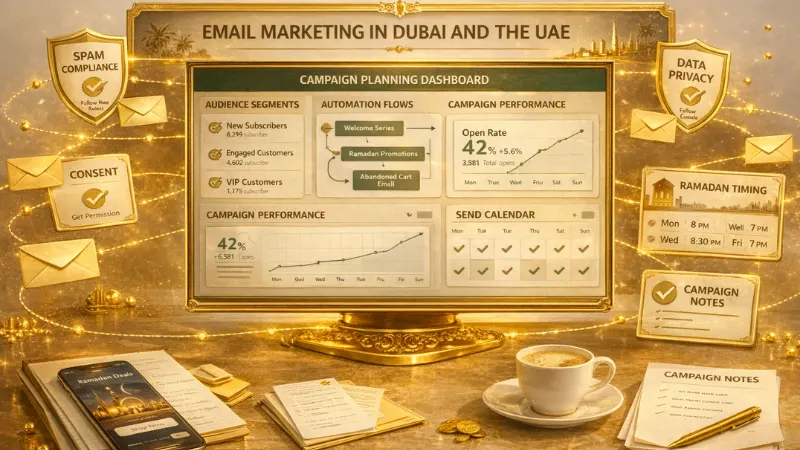

Does email still work in 2026? In the UAE, the answer is yes — and the data is unusually clear about it. Email open rates in the UAE average 25–30%, higher than the global benchmark of around 21%. With internet penetration at 99% and smartphone penetration above 95%, UAE consumers and business professionals read their email — often multiple times per day on mobile.
Yet most Dubai businesses either ignore email marketing entirely or treat it as a bulk-blast channel: upload a list, send a promotional newsletter, hope for responses. That approach explains why so many campaigns underperform. This guide covers how email marketing actually works in the UAE market: strategy, platform selection, Ramadan-specific scheduling, UAE data protection compliance, and what measurable success looks like.
Why Email Marketing Delivers Strong ROI in the UAE
Three factors make email particularly effective in the UAE market:
- —High professional email reliance. Dubai’s business culture runs on email. Professionals across DIFC, Business Bay, Dubai Internet City, and every free zone treat inbox communication as a primary business channel. Unlike social media — where a post competes with hundreds of others in a feed — an email lands directly in a named recipient’s inbox.
- —ROI that compounds with quality execution. Email consistently returns AED 20–120 per dirham spent when campaigns are well-targeted and properly automated. Compare that to Google Ads or paid social, where costs increase with competition and results stop the moment spending stops.
- —Direct control over your audience. Social media platforms change algorithms. Ad costs increase. A well-maintained email list is an asset your business owns directly. No platform dependency, no algorithmic throttling, no sudden reach drop when a social network updates its policies.
For B2B businesses, professional services firms, e-commerce brands, and hospitality operators across the UAE, email marketing sits at the intersection of lead nurturing, customer retention, and direct revenue generation — often outperforming paid channels on cost-per-acquisition over a 12-month horizon.
Understanding the UAE Email Audience
Dubai’s population is around 88% expatriate, drawn from South Asia, the Arab world, Europe, North America, East Asia, and Africa. This diversity shapes how email marketing should be planned:
- —Language. English is the primary business language. Arabic is required or strongly preferred for government-facing communications, local retail, and audiences that include UAE nationals, Emiratis, and Arab expat communities. Bilingual emails — with English and Arabic in the same campaign — consistently outperform monolingual sends when targeting a mixed UAE audience.
- —Cultural sensitivity. UAE audiences respond well to content that respects Islamic values, acknowledges local calendar events (Ramadan, Eid, UAE National Day, Dubai Shopping Festival), and avoids assumptions common in Western marketing copy.
- —Mobile-first behaviour. 76% of emails in the UAE are opened on mobile devices. Any email that isn’t designed for mobile — with a single-column layout, large tap targets, and minimal images — loses most of its audience before the first scroll.
- —High-volume inbox competition. Dubai professionals receive significant email volume. Subject lines must be specific, relevant, and personalised to earn an open. Generic subject lines like “Our latest newsletter” are ignored.
Building a UAE Email Marketing Strategy: Step by Step
1Define Clear Campaign Objectives
Every email campaign should have a single, measurable objective. Common goals for UAE businesses include:
- —Generating leads from new contacts (top-of-funnel)
- —Nurturing existing leads toward a purchase or meeting
- —Re-engaging inactive contacts
- —Driving repeat purchases from existing customers (e-commerce, F&B, retail)
- —Building event attendance
Mixing objectives in a single campaign — “promote our service AND share company news AND announce our new team member” — dilutes the call to action and reduces conversion rates. One email, one goal.
2Build and Segment Your List Properly
The quality of your email list determines the quality of your results. A list of 500 opted-in, engaged contacts will outperform a purchased list of 50,000 cold addresses every time — and it keeps your sender reputation intact.
Segmentation is what turns a good list into a high-performing one. At minimum, segment by:
- —Engagement level — who opened your last five emails vs. who hasn’t opened in 90 days
- —Funnel stage — new leads get different content than existing customers
- —Industry or sector — for B2B senders, a message relevant to a retail client may be irrelevant to a logistics company
- —Language preference — English-only vs. bilingual audiences
Platforms like HubSpot, Mailchimp, and Klaviyo all support contact segmentation. Use it from day one, not as an afterthought when your list has grown to thousands.
3Choose the Right Email Platform
Your choice of email platform shapes what you can do with automation, personalisation, and reporting. Here’s how the main options compare for UAE businesses:
| Platform | Best For | Starting Cost | Key Strengths |
|---|---|---|---|
| HubSpot | B2B, CRM-integrated marketing | Free tier; paid from ~AED 735/month | CRM + email + automation in one platform; excellent reporting |
| Mailchimp | SMBs, e-commerce, growing lists | Free up to 500 contacts; paid from ~AED 55/month | Easy to use; strong templates; Shopify and WooCommerce integration |
| Klaviyo | E-commerce (Shopify, WooCommerce) | Free up to 500 contacts; paid from ~AED 165/month | Deep behavioural triggers; revenue attribution; cart abandonment flows |
| ActiveCampaign | Mid-size businesses needing complex automation | From ~AED 295/month | Most powerful automation builder; CRM + email + SMS |
| Zoho Campaigns | Businesses already using Zoho CRM | Free up to 2,000 contacts; paid from ~AED 36/month | Strong Zoho CRM integration; Arabic language interface available |
| Sendinblue (Brevo) | Small businesses, transactional email | Free up to 300 emails/day; paid from ~AED 55/month | SMS + email in one; strong deliverability tools; affordable at high volumes |
For most UAE businesses starting their email programme, Mailchimp or HubSpot cover the majority of needs. If you run an e-commerce store on Shopify, Klaviyo’s behavioural automation — triggered by browse history, cart abandonment, and purchase patterns — is worth the higher cost. B2B businesses with a CRM investment in Zoho should consider Zoho Campaigns before adding a separate platform.
4Plan Around the UAE Calendar
The UAE business calendar differs significantly from Western markets. Effective email marketing in Dubai requires planning around local events rather than importing a generic Western campaign calendar.
Ramadan is the most important planning consideration. Consumer behaviour shifts significantly during Ramadan — spending increases (particularly in retail, food, and gifting), but timing is critical. Open rates for evening and late-night sends improve because people are awake during Iftar and Suhoor hours. Promotional content should be respectful and not focus on food, alcohol, or entertainment-heavy messaging. Many UAE businesses see their highest email engagement of the year during the Ramadan countdown and the first week of Ramadan.
Dubai Shopping Festival (December–January) drives major retail spending. If your business serves consumers directly, this period deserves a dedicated email campaign series — not a single generic promotional email.
UAE National Day (2 December) is a strong brand awareness moment. Campaigns that acknowledge UAE National Day appropriately — without being performative — tend to resonate well with local and Arab expat audiences.
Summer (June–August) is the slowest period for most Dubai businesses, as heat drives many residents abroad. B2C email engagement drops. B2B campaigns can still perform well since decision-makers often catch up on reading during the slower pace.
5Write Emails That Get Opened and Acted On
Subject line and preview text are the most important parts of any email — they determine whether it gets opened or ignored. For UAE audiences:
- —Personalise with the recipient’s first name and, where possible, their company or sector
- —Be specific: “Your SEO campaign report for March” outperforms “Your monthly update”
- —Keep subject lines under 50 characters for mobile preview
- —Test two subject line variants using A/B testing — even on a list of 500 contacts, this produces useful data over time
In the email body, follow this structure for most campaign types: one clear message, one clear call to action, and enough context to earn the click — nothing more. Emails that try to cover five topics with five buttons convert worse than emails with a single focused message.
6Automate Your Highest-Value Sequences
Email automation delivers results while you sleep. The four automation sequences that produce the highest ROI for UAE businesses are:
- —Welcome sequence (3–5 emails over 10 days). New subscribers receive a guided introduction to your business, your core value proposition, and a relevant offer or resource. Automated welcome sequences generate 3x the revenue per email of standard broadcasts.
- —Lead nurture sequence (for B2B). Leads who download a resource or submit a contact form receive a sequence that builds trust, answers common objections, and moves toward a sales conversation over two to four weeks.
- —Abandoned cart recovery (for e-commerce). A three-email sequence sent at one hour, 24 hours, and 72 hours after an abandoned cart typically recovers 5–15% of lost revenue. Klaviyo and Mailchimp both support this natively.
- —Re-engagement campaign. Contacts who haven’t opened in 90 days receive a reactivation sequence. Those who don’t respond should be removed from your active list to protect your sender reputation and deliverability rates.
UAE Data Protection Compliance: What You Must Know
Email marketing in the UAE is governed by Federal Decree-Law No. 45 of 2021 on the Protection of Personal Data. This law came into force in January 2022 and has significant implications for any business sending marketing emails to UAE residents.
The key compliance requirements for email marketing:
- —Explicit consent required. You must obtain clear, affirmative opt-in consent before sending marketing emails. Pre-ticked boxes and assumed consent do not satisfy the law’s requirements.
- —Easy opt-out. Every marketing email must contain a clear and functional unsubscribe mechanism. Recipients must be able to opt out simply and have their request honoured promptly.
- —Data minimisation. Collect only the personal data you actually need for your stated marketing purpose. Requesting excessive data fields on sign-up forms without justification creates compliance risk.
- —Transparency about data use. Your email sign-up process should link to a Privacy Policy that clearly explains how subscriber data is stored, processed, and used.
- —No unauthorised data sharing. Sharing or selling your email list to third parties without subscriber consent is a breach of the law.
Practically, this means: stop buying email databases and blasting them. The short-term reach isn’t worth the deliverability damage and legal exposure. Build your list through legitimate opt-in channels — website sign-up forms, lead magnets, event registrations, and customer opt-in at point of sale.
Key Metrics for UAE Email Marketing
Measuring the right metrics determines whether you optimise toward real business outcomes or vanity numbers.
| Metric | UAE Benchmark | What It Tells You |
|---|---|---|
| Open rate | 25–30% | Subject line effectiveness and list quality |
| Click-through rate (CTR) | 2.5–4% | Relevance of content and strength of call to action |
| Click-to-open rate (CTOR) | 10–15% | How compelling the email body is once opened |
| Conversion rate | 1–3% (varies widely by offer) | Whether the campaign drives the intended action |
| Unsubscribe rate | Under 0.5% | Content relevance and sending frequency |
| Bounce rate | Under 2% | List hygiene — high bounce rates damage sender reputation |
If your open rate is consistently below 20%, the priority is subject line testing and list segmentation. If your CTR is low despite reasonable opens, the email body and call to action need revision. If your unsubscribe rate spikes after a specific campaign, that campaign’s content or frequency was off.
Integrating Email with Your Wider UAE Marketing Strategy
Email marketing performs best as part of a connected strategy — not a standalone channel. When we work with clients on their customer acquisition and retention strategy in Dubai, email sits within a broader system that includes SEO-driven content (which grows the subscriber list), marketing automation workflows (which extend email into WhatsApp, SMS, and CRM sequences), and paid social (which retargets email subscribers who haven’t converted).
WhatsApp is a particularly important secondary channel in the UAE. Smartphone penetration is near-universal and WhatsApp is used for both personal and professional communication in ways that are unique to the region. Combining email nurture sequences with WhatsApp follow-ups — for B2B lead gen specifically — often doubles engagement compared to email alone.
If you’re ready to build or improve your email marketing programme in Dubai, our acquisition and retention team can audit your current setup, design your automation sequences, and help you build a list strategy that grows sustainably.
Frequently Asked Questions
Q
What is the 60 40 rule in email?
The 60/40 rule suggests that email content should be roughly 60% images and 40% text. In practice, many email deliverability experts now recommend a higher proportion of text because image-heavy emails trigger spam filters and don’t render in all email clients. For UAE business audiences, a text-primary layout with supporting visuals usually performs better than image-dominant designs.
Q
How much do email marketers make in Dubai?
An email marketing specialist in Dubai typically earns between AED 8,000 and AED 18,000 per month depending on experience, the complexity of the campaigns they manage, and whether they handle automation strategy alongside execution. Senior email marketing managers in larger organisations can earn AED 20,000–28,000 per month.
Q
How can I send 5,000 emails for free in the UAE?
Mailchimp’s free plan allows up to 500 contacts and 1,000 monthly email sends. Brevo (formerly Sendinblue) offers up to 300 emails per day on its free tier. Zoho Campaigns allows 2,000 contacts and 6,000 emails per month for free. None of these free tiers include advanced automation or A/B testing, but they’re a legitimate starting point for small businesses building their first email programme.
Q
What is the 80 20 rule in email marketing?
In email marketing, the 80/20 rule means roughly 80% of your content should provide value — education, useful information, practical insights — and only 20% should be directly promotional. Audiences in the UAE, as elsewhere, disengage quickly from brands that send purely promotional emails without delivering genuine value in between.
Q
Is email marketing legal in the UAE?
Yes, but it requires compliance with Federal Decree-Law No. 45 of 2021 on Personal Data Protection. You must obtain explicit opt-in consent before sending marketing emails, provide a clear and functional unsubscribe mechanism, and handle personal data in accordance with the law’s data minimisation and transparency requirements.
Related Reading
Email marketing works best as part of a broader lead generation system in Dubai — where email nurtures prospects that other channels have attracted.
In the UAE market, email and WhatsApp marketing complement each other well — email for longer-form nurture, WhatsApp for high-urgency moments.
For B2B businesses, email is particularly powerful. Our B2B digital marketing UAE guide covers how email fits into the full channel mix.