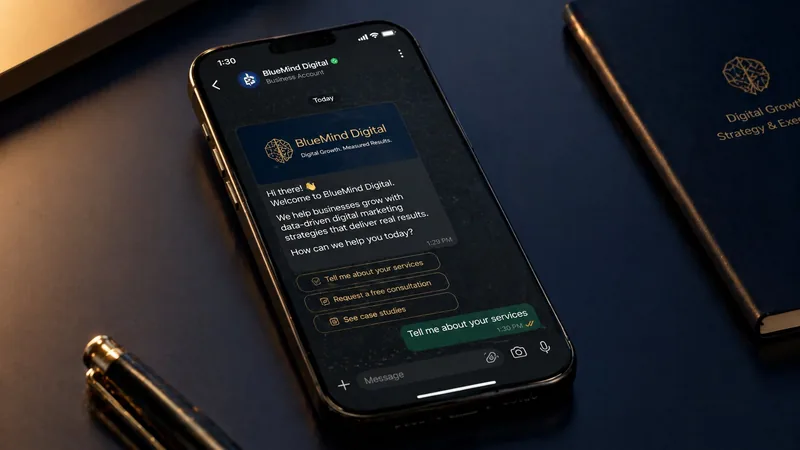
In the UAE, WhatsApp isn’t just a messaging app — it’s an infrastructure.
Businesses use it to send quotes, confirm appointments, share documents, provide customer support, and maintain ongoing relationships with clients. Customers expect WhatsApp as a communication option in the same way they expect an email address. For many UAE transactions, a WhatsApp conversation is where the deal actually happens.
This guide covers how Dubai businesses can use WhatsApp deliberately and strategically — as a marketing and communication channel that drives real commercial outcomes — rather than just reactively replying to messages as they arrive.
WhatsApp in the UAE: The Numbers That Matter
WhatsApp penetration in the UAE is among the highest globally. Nearly every smartphone user in the country has WhatsApp installed and uses it daily. It transcends age, nationality, and demographic segment in a way that no other platform in the UAE can claim.
For businesses, this creates a direct line to customers that:
– Arrives in a highly personal, low-noise environment (compared to crowded email inboxes)
– Benefits from read rates dramatically higher than email (typically 85–95% vs email’s 20–30%)
– Enables rich media sharing — images, videos, PDFs, voice messages, location
– Feels natural and convenient to the UAE customer
The question for Dubai businesses isn’t whether to use WhatsApp — they already are. The question is whether they’re doing it strategically.
WhatsApp Business vs WhatsApp Business API: What’s the Difference?
WhatsApp Business (Free App)
The mobile app designed for small businesses. Key features:
– Business profile with opening hours, description, website, and address
– Quick replies for frequently sent messages
– Labels for organising conversations (new customer, payment pending, etc.)
– Broadcast lists for sending messages to up to 256 contacts at once
– Automated greeting and away messages
– Product catalogue for showcasing services
Best for: Small businesses with manageable message volumes and primarily one-to-one customer conversations.
WhatsApp Business API
The enterprise-grade solution for businesses needing scale, automation, and integration. Requires a verified business and is accessed through a Business Solution Provider (BSP) or platforms like Trengo, WATI, Respond.io, or Zoko.
Key API features:
– Unlimited broadcasts (with opt-in contacts)
– Automated conversation flows and chatbots
– CRM integration
– Multi-agent inbox (multiple team members handling conversations simultaneously)
– Message templates for proactive outreach (require WhatsApp approval)
– Rich analytics and reporting
Best for: Businesses with significant message volumes, multiple support agents, or requiring automated conversation management.
How Dubai Businesses Can Use WhatsApp Strategically
1. Lead Capture and Instant Response
Speed of response is a major conversion factor in Dubai’s competitive business environment. Adding a WhatsApp click-to-chat button to your website, Google Ads landing pages, and Instagram profile converts enquiries into conversations immediately — often achieving significantly higher lead-to-conversation rates than email forms.
Pro tip: Set up an instant automated greeting when a prospect initiates contact. “Hi! Thanks for reaching out to [Business Name]. Someone from our team will respond within [timeframe]. In the meantime, could you tell us a bit about what you’re looking for?”
2. Appointment Reminders and Confirmations
Healthcare clinics, beauty salons, consultants, and any appointment-based business in Dubai benefits enormously from WhatsApp appointment reminders. Cancellation rates drop dramatically when clients receive a friendly WhatsApp confirmation 24 hours before their appointment.
3. Post-Purchase and Customer Nurture
For ecommerce businesses and service providers, WhatsApp enables post-purchase communication that builds retention and loyalty:
– Order confirmation and delivery tracking updates
– After-service check-ins (feedback request, cross-sell opportunity)
– Re-engagement campaigns for lapsed customers
4. Broadcast Campaigns to Opted-In Contacts
This is where WhatsApp becomes a genuine marketing broadcast channel. Businesses with a list of opted-in contacts — customers who have explicitly agreed to receive messages — can send promotional broadcasts with open rates that email marketers can only dream of.
Important: WhatsApp’s terms strictly require explicit opt-in from recipients before marketing messages are sent. Unsolicited broadcasts are a terms-of-service violation and risk your account being banned. Build your opted-in list properly from day one.
5. Customer Support and Satisfaction
A WhatsApp channel for customer support reduces ticket volume on other channels, improves resolution speed, and increases customer satisfaction. UAE customers expect fast, convenient support — WhatsApp delivers both.
WhatsApp and UAE Regulations
Is WhatsApp marketing legal in UAE?
Yes — WhatsApp marketing is entirely legal in the UAE provided it is done with proper consent and in accordance with both WhatsApp’s own Business Policy and the UAE’s applicable consumer protection and data privacy frameworks.
The key requirement is explicit opt-in: recipients must have actively consented to receive marketing messages from your business. Purchased contact lists used for WhatsApp broadcasts are not compliant and risk serious consequences including account suspension.
The UAE’s Telecommunications and Digital Government Regulatory Authority (TDRA) regulates electronic communications, and sending unsolicited commercial messages to individuals without consent is prohibited under UAE law.
Best practice: Capture WhatsApp opt-in at the point of first contact — on your website’s contact form, at point of sale, or as part of your service sign-up process.
Integrating WhatsApp with Your Marketing Stack
WhatsApp works best when it’s connected to your broader marketing and CRM systems:
- —CRM integration: Connect WhatsApp conversations to your CRM so that every interaction is logged and visible to your sales team
- —Facebook Ads with WhatsApp CTA: Run Meta ads with a “Send WhatsApp Message” call-to-action, which opens a direct WhatsApp conversation — highly effective for lead generation
- —Google Ads call extensions: Use a WhatsApp number as an ad extension for high-intent search traffic
- —Email + WhatsApp sequences: Use email for longer-form nurture; WhatsApp for quick nudges and high-urgency messages
For more on how messaging fits into a complete digital marketing strategy, see our Social Media Advertising Dubai guide and Email Marketing in Dubai guide.
Valasys Media and WhatsApp Strategy
Valasys Media helps UAE businesses integrate WhatsApp into their digital marketing and lead management systems — from initial setup and opt-in strategy through to API integration and automated conversation flows. Contact our team to discuss building a WhatsApp marketing system for your business.
Conclusion
WhatsApp is the most natural marketing channel for Dubai businesses because it’s already where their customers are. The opportunity isn’t to convince people to adopt a new behaviour — it’s to engage an existing behaviour more deliberately and systematically.
Build your opted-in list from day one, use automation to respond instantly, and connect WhatsApp to your CRM and marketing stack. The result is a high-conversion communication channel that works harder than any other you’ll deploy in the UAE market.
Frequently Asked Questions: WhatsApp Marketing Dubai
Q
Is WhatsApp marketing legal in the UAE?
Yes, WhatsApp marketing is entirely legal in the UAE — provided you have explicit opt-in consent from recipients before sending marketing messages. The UAE’s Telecommunications and Digital Government Regulatory Authority (TDRA) prohibits unsolicited commercial messages, and WhatsApp’s own Business Policy requires that recipients have agreed to receive messages from your business. Purchased contact lists used for unsolicited broadcasts are non-compliant and risk account suspension and potential legal consequences.
Q
What is the difference between WhatsApp Business and the WhatsApp Business API?
WhatsApp Business is the free mobile app designed for small businesses — it allows broadcast lists of up to 256 contacts, quick replies, a business profile, and basic automation (greeting and away messages). The WhatsApp Business API is the enterprise solution for businesses needing scale — unlimited broadcasts to opted-in contacts, chatbot automation, CRM integration, multi-agent inbox, and advanced analytics. The API requires setup through a Business Solution Provider and has monthly costs depending on message volumes.
Q
How do I build a WhatsApp marketing list in Dubai?
Build your opted-in WhatsApp list through consent-based touchpoints: a WhatsApp opt-in checkbox on your website contact form, a QR code at your physical location or on receipts, an opt-in during service sign-up or checkout, and clear invitation in your email communications. Never add contacts without their explicit consent. Quality of your list matters far more than size — 500 opted-in, engaged contacts will outperform 5,000 unsolicited numbers.
Q
How do businesses use WhatsApp to generate sales in the UAE?
Most effectively through: a WhatsApp click-to-chat button on your website and ads that converts enquiries to instant conversations (dramatically improving lead response time), broadcast campaigns to opted-in customers promoting new products, offers, or seasonal events, abandoned cart or follow-up sequences for ecommerce businesses, appointment reminders that reduce no-shows, and post-service check-ins that generate reviews and repeat business.
Q
Can I run WhatsApp ads in Dubai?
Yes — Meta allows you to run Facebook and Instagram ads with a “Send WhatsApp Message” call-to-action, which opens a direct WhatsApp conversation when clicked. These click-to-WhatsApp ads are highly effective in the UAE market because WhatsApp is the preferred communication channel for many UAE consumers. They work particularly well for high-consideration purchases where a conversation with a real person significantly improves conversion.
Q
What should I not do with WhatsApp marketing in the UAE?
Never send unsolicited messages to contacts who haven’t opted in — this violates WhatsApp’s terms and UAE law. Don’t send messages at inappropriate hours (late evening or very early morning). Avoid overly frequent broadcasts that feel spammy — more than 1–2 per week risks contacts blocking your number. Don’t use informal broadcast lists to send promotional content to business contacts who gave you their number for other purposes.