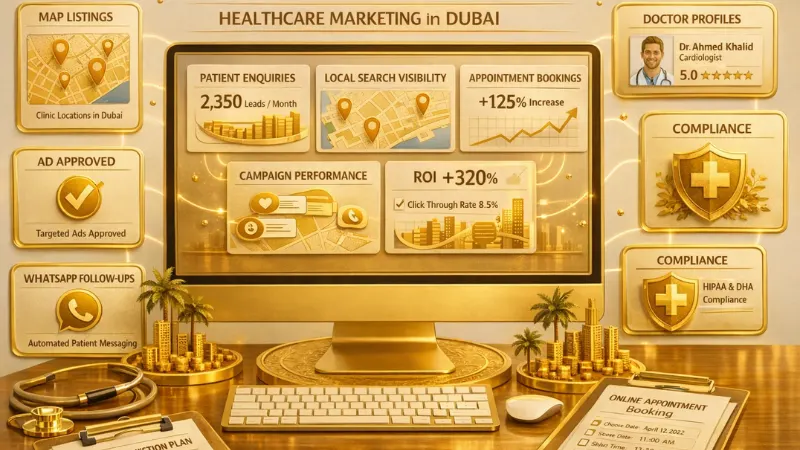
92% of UAE patients research healthcare providers online before booking. 74% book appointments via mobile. If your clinic isn’t visible in Google when someone searches for a dermatologist in JLT or a physiotherapist in Business Bay, you’re invisible to the majority of potential patients — no matter how good your clinical outcomes are.
Dubai’s healthcare market is projected to reach AED 100 billion and growing, with more clinics and hospitals opening in the city every year. The practices that grow consistently aren’t necessarily the ones with the best facilities — they’re the ones that have built the strongest digital presence and understand how to attract patients while staying fully compliant with DHA and MOHAP regulations.
This guide covers what a healthcare marketing strategy in Dubai actually looks like, which channels work for which provider types, and the specific UAE regulatory rules that apply to every campaign you run.
Why Healthcare Marketing in Dubai Is Different
Three factors make healthcare marketing in the UAE meaningfully different from other sectors:
- —Strict regulatory oversight. The Dubai Health Authority (DHA) and UAE Ministry of Health and Prevention (MOHAP) regulate all medical marketing in the country. Every advertisement for a licensed healthcare facility or practitioner must comply with specific rules around claims, disclaimers, testimonials, and prohibited content. Non-compliance isn’t just a reputational risk — it can result in fines and licence suspension.
- —A highly diverse patient audience. Dubai’s population of over 3.5 million includes Emirati nationals, Arab expatriates, South Asian communities, European and Western expatriates, and medical tourists from across the region. Each group has different information needs, language preferences, and trust signals. A single English-language campaign misses the majority of the market.
- —High patient expectations. Dubai’s population includes some of the world’s most digitally engaged consumers. They research, compare, read reviews, and check credentials before their first appointment. A weak online presence or low Google rating loses patients before they’ve ever contacted your practice.
DHA and MOHAP Compliance: What Every Healthcare Marketer Must Know
Before covering strategy, compliance must be addressed — because a well-designed campaign that violates UAE healthcare advertising regulations can be taken down and result in regulatory action against your facility.
Key rules for all healthcare marketing in Dubai:
- —Licence display. All marketing materials and advertisements must display your facility’s valid DHA or MOHAP licence number clearly. This applies to website pages, social media profiles, Google Ads, and printed materials.
- —No guaranteed outcomes. Phrases like “guaranteed cure,” “100% success rate,” or “permanent results” are prohibited. Claims must be accurate, verifiable, and not misleading. Even implying guaranteed outcomes in visual content can trigger a compliance review.
- —Testimonial restrictions. Clinical testimonials — where a patient attributes a specific treatment outcome to a doctor — are heavily restricted under UAE regulations. Patient experience testimonials (describing professional staff, clean facilities, or smooth processes) are permissible. Before-and-after images require specific licensing for use in social media advertisements.
- —Drug and treatment name restrictions in Google Ads. You cannot use trademarked drug names (such as Botox, Ozempic, or Juvederm) in Google Ads copy without manufacturer authorisation. Healthcare facilities targeting cosmetic or weight management patients must use generic descriptions: “anti-wrinkle injections,” “medical weight management,” or “dermal fillers” rather than brand names.
- —UAE Personal Data Protection Law (PDPL). Patient data is among the most sensitive data categories under Federal Decree-Law No. 45 of 2021. Any CRM, email marketing, or remarketing activity involving patient data requires explicit consent, clear data use disclosure, and secure handling practices. Patient details collected through appointment forms cannot be used for marketing purposes without opt-in consent.
Working with a digital marketing agency that doesn’t have specific UAE healthcare regulatory knowledge is a compliance risk. Confirm that your agency understands DHA and MOHAP advertising requirements before engaging them for healthcare campaigns.
The Healthcare Marketing Channels That Deliver Results in Dubai
Local SEO and Google Business Profile
When a Dubai resident searches for “gynaecologist near Dubai Hills” or “dermatology clinic Business Bay,” the Google Map Pack — the three businesses shown on the map — dominates the screen. Appearing in the Map Pack for your speciality and location is the single highest-value action for most private clinics in Dubai.
Getting there requires:
- —A fully optimised and regularly updated Google Business Profile (GBP) — correct opening hours, photos, service descriptions, and DHA licence displayed
- —Active review management — responding to all reviews, including negative ones, professionally and promptly
- —Consistent NAP (Name, Address, Phone) data across your website, GBP, and all third-party directories
- —Local citation building on UAE healthcare directories and general business listings
In our experience working with healthcare providers, clinics that actively managed their GBP — including weekly photo updates and consistent review responses — saw local search visibility improvements within six to eight weeks. It’s the highest-ROI quick win in healthcare digital marketing.
SEO for Medical Conditions and Specialties
Patients searching “lower back pain treatment Dubai” or “IVF clinic UAE” are in high-intent research mode. Creating content that answers these searches — in the form of condition pages, treatment explainer articles, and doctor profile pages — builds long-term organic traffic that grows without ongoing ad spend.
For Google to rank healthcare content, E-E-A-T (Experience, Expertise, Authoritativeness, Trustworthiness) signals matter more than in any other industry. Medical content written by or reviewed by a licensed, credentialled practitioner dramatically outperforms generic content. Author credentials, faculty qualifications, and DHA licence numbers are all trust signals Google weighs in healthcare search rankings.
Google Ads for Healthcare Services
Google Search Ads capture patients who are actively searching for a specific service or specialty right now. For high-value specialties with longer consideration periods — fertility treatment, orthopaedic surgery, cosmetic procedures — Google Ads generate leads that organic SEO may take months to reach.
Average CPCs for healthcare-related keywords in Dubai range from AED 8–40 depending on the specialty and competitive intensity:
| Specialty / Service | Estimated CPC Range (Dubai) | Competition Level |
|---|---|---|
| General practice / family medicine | AED 5–15 | Medium |
| Dental (general) | AED 8–20 | High |
| Cosmetic procedures (non-branded) | AED 12–30 | High |
| Fertility / IVF | AED 15–35 | High |
| Orthopaedics / sports medicine | AED 10–25 | Medium–High |
| Physiotherapy | AED 5–15 | Medium |
Healthcare Google Ads must land on dedicated service pages — not your homepage. A patient who clicked an ad for “knee replacement Dubai” and lands on a general hospital homepage will not convert. Every campaign needs a DHA-compliant landing page with clear treatment descriptions, doctor credentials, and a single, friction-free call to action (typically a WhatsApp or phone call, given that UAE patients strongly prefer WhatsApp for medical appointment enquiries).
Social Media for Healthcare Providers
Instagram and Facebook remain the dominant platforms for consumer-facing healthcare marketing in Dubai. The format that consistently builds trust fastest is short-form educational video from credentialled doctors — a 60-second Reel explaining a common condition in plain language, answering a frequently asked patient question, or walking through a treatment process.
Practical social media guidance for Dubai healthcare providers:
- —Publish in both English and Arabic. Arabic-language content drives disproportionate engagement among UAE nationals and Arab expatriate communities, who make up a significant share of private healthcare users in Dubai
- —Showcase the doctors, not just the facility. Patient trust in healthcare is personal — faces and credentials build it; building photos and reception shots don’t
- —Never post identifiable patient images without written, legally reviewed consent
- —Avoid making comparative claims (“the best clinic in Dubai,” “Dubai’s #1 specialist”) — DHA guidelines prohibit superiority claims without verifiable evidence
WhatsApp as a Patient Communication Channel
WhatsApp is used for scheduling, follow-up, prescription communication, and general patient queries throughout the UAE healthcare system — by both large hospital networks and individual private clinics. For marketing purposes, WhatsApp Business API can support appointment reminders, post-consultation follow-up messages, and health tip campaigns to opted-in patients. It’s one of the highest open-rate channels in the UAE market, far exceeding email for most patient demographics.
Any WhatsApp marketing campaign to patients requires explicit opt-in consent, is subject to the UAE PDPL, and must not share patient information or treatment details in any marketing context without the patient’s direct authorisation.
Reputation Management and Patient Reviews
A study of Dubai healthcare consumer behaviour found that over 78% of UAE patients cite online reviews as a significant factor in provider selection. Google reviews are the most influential. A clinic with 4.8 stars and 200 reviews outperforms a clinic with 4.5 stars and 20 reviews, even when other factors are equal.
Active reputation management includes:
- —Systematically requesting reviews from satisfied patients at the point of discharge or post-appointment SMS/WhatsApp follow-up
- —Responding to every negative review professionally, within 24 hours, without disclosing any patient clinical information in the public response
- —Monitoring third-party healthcare review platforms: Practo, Okadoc, Zocdoc UAE, and Google — each attracts different patient demographics
Medical Tourism: A Specific Marketing Channel in Dubai
Dubai attracted over 700,000 medical tourists in 2024, with high volumes from GCC countries, India, Russia, Europe, and increasingly East Africa. For hospitals and specialist clinics targeting medical tourists, the digital strategy requires a separate channel approach:
- —International SEO in English, Arabic, Russian, and Hindi targeting procedures Dubai is known for: cosmetic surgery, cardiac care, orthopaedics, fertility, and oncology
- —Google Ads with geographic targeting on origin countries, not just Dubai
- —YouTube content demonstrating clinic facilities and featuring doctor credentials in languages relevant to target markets
- —Partnership with UAE medical tourism facilitators and insurance networks including Daman, AXA (now GIG Gulf), and NextCare
Recommended Budget for Healthcare Digital Marketing in Dubai
A realistic starting budget for a private clinic running a focused digital marketing programme in Dubai:
- —SEO and content (local + condition pages): AED 3,000–6,000/month
- —Google Ads management: AED 1,500–3,000/month agency fee + AED 5,000–15,000/month ad spend (specialty-dependent)
- —Social media management (Instagram + Facebook, bilingual): AED 3,000–6,000/month
- —Total monthly range for a mid-size private clinic: AED 12,000–30,000
These figures align with what serious clinics in Dubai invest — and what creates competitive patient acquisition results over a six-to-twelve-month horizon. Programmes at the lower end of this range focus on foundational SEO and organic social. Programmes at the higher end run active Google Ads alongside content and social, which accelerates patient volume growth substantially.
Our content marketing and PPC campaign teams work with healthcare providers in Dubai on DHA-compliant digital strategies. If you’re a clinic or hospital looking to improve your online presence and patient acquisition pipeline, get in touch and we’ll put together a tailored plan.
Frequently Asked Questions
Q
What is a healthcare marketing agency?
A healthcare marketing agency specialises in digital marketing for clinics, hospitals, and healthcare providers. In the UAE, this requires specific expertise in DHA and MOHAP advertising compliance, healthcare SEO, medical Google Ads with restricted terminology, and patient-facing content that meets E-E-A-T standards. General digital marketing agencies without healthcare specialisation often miss the regulatory requirements that make UAE healthcare campaigns compliant and effective.
Q
How do clinics market themselves in Dubai?
The most effective channels for clinic marketing in Dubai are local SEO and Google Business Profile (for proximity-based patient acquisition), Google Search Ads targeting specialty keywords, Instagram and Facebook with bilingual English and Arabic content, and active review management on Google and healthcare platforms like Practo and Okadoc. WhatsApp Business is widely used for appointment follow-up and patient retention.
Q
What are the DHA rules for healthcare advertising in Dubai?
Key DHA requirements include: displaying a valid DHA licence number on all marketing materials, no guaranteed outcome claims, restricted use of clinical patient testimonials, compliance with before-and-after image guidelines, prohibition on “best” or “number one” claims without verified evidence, and full compliance with the UAE PDPL for any patient data used in marketing activities.
Q
How much does healthcare marketing cost in Dubai?
A comprehensive healthcare digital marketing programme for a mid-size private clinic in Dubai typically costs AED 12,000–30,000 per month, covering SEO, Google Ads management (plus ad spend), and bilingual social media management. Focused programmes on a single channel (SEO-only or social-only) can start at AED 3,000–6,000 per month. The investment needed depends on specialty competitiveness and patient acquisition targets.
Q
Is B2B healthcare marketing different from patient-facing marketing?
Yes. B2B healthcare marketing — targeting insurers, corporates offering employee health benefits, or procurement for hospital supplies and equipment — uses LinkedIn, industry events, content marketing, and email campaigns targeting decision-makers rather than patients. The regulatory restrictions on clinical claims still apply, but the channel mix, messaging, and conversion goals are entirely different from patient acquisition campaigns.
Related Reading
For clinics, local search is the primary discovery channel. Our local SEO Dubai guide covers Google Business Profile and Maps optimisation for healthcare providers.
Building a consistent patient pipeline requires a multi-channel approach. Our lead generation Dubai guide covers the systems and channels that work for healthcare businesses.
WhatsApp is the primary communication channel for UAE healthcare providers. Our WhatsApp marketing Dubai guide covers appointment reminders, follow-ups, and opt-in best practices.